

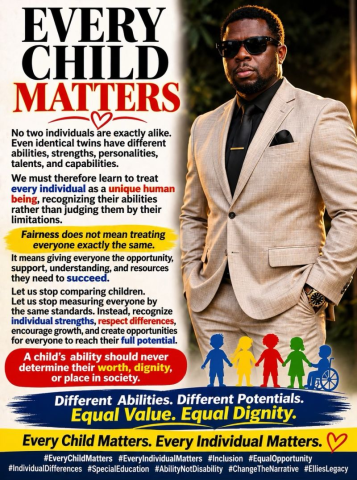
No two individuals are exactly alike
EVERY CHILD MATTERS: Different Abilities, Different Potentials, Equal Value, and Equal Dignity
Introduction
Every child matters, regardless of their abilities, background, developmental differences, or the challenges they may face in life. Every child deserves to feel loved, accepted, respected, and given an opportunity to succeed. Unfortunately, we live in a society where children are sometimes compared to one another, judged by academic performance, or defined by what they cannot do rather than what they can achieve.
I believe it is time to change that way of thinking. No two individuals are exactly alike. Even children growing up in the same household or identical twins can have different personalities, strengths, interests, talents, and abilities. We should not expect every child to learn, communicate, behave, or develop in exactly the same way. Instead, we should take the time to understand each child as an individual and recognize the potential that exists within them.
The United Nations (1989), through the Convention on the Rights of the Child, emphasizes that children should be protected from discrimination, including discrimination based on disability. This reminds us that every child deserves equal respect, protection, and opportunities.
Understanding and Respecting Individual Differences
Through my professional experience in special education and developmental disability services, I have come to appreciate that individuals learn, communicate, and express themselves in different ways. Some children may learn quickly in a traditional classroom, while others may need additional time, individualized instruction, patience, and support.
For example, a nonverbal child may communicate through gestures, facial expressions, or assistive technology. Another child may need additional assistance with everyday activities but still have wonderful abilities, interests, and a desire to participate in the world around them.
These differences should never become reasons to underestimate or exclude anyone.
As a developmental disability associate assistant manager, I understand that providing support is not simply about identifying what an individual cannot do. It also means recognizing their abilities, encouraging independence, respecting personal choices, and creating opportunities for growth.
Let's stop defining children by their limitations and start recognizing their strengths. A disability is only one part of an individual's life; it does not define their entire identity or determine their worth.
Fairness Does Not Mean Treating Everyone Exactly the Same
One important message I want people to understand is that fairness does not always mean treating everyone exactly the same. Sometimes, fairness means recognizing that people have different needs and providing the support they need to succeed.
For instance, one student may complete an assignment independently, while another may require additional time, assistive technology, or individualized educational support. Both students deserve the opportunity to learn, participate, and demonstrate their abilities.
Providing additional assistance does not mean giving someone an unfair advantage. It means recognizing individual differences and removing unnecessary barriers.
The Individuals with Disabilities Education Act supports this principle by emphasizing that children with disabilities should receive appropriate educational services and, to the maximum extent appropriate, learn alongside their peers without disabilities (U.S. Department of Education, n.d.).
Similarly, UNESCO (2020) explains the importance of inclusive education and the need to address barriers that prevent individuals from fully participating in educational opportunities.
To me, fairness looks like understanding individual needs, providing appropriate resources, and giving every child a genuine opportunity to succeed.
The Importance of Inclusion in Education and Society
Inclusion should be more than a word we use in schools, workplaces, healthcare facilities, and community organizations. We should demonstrate it through our actions.
Children with developmental disabilities and special educational needs deserve to be included in classroom activities, community programs, social interactions, and other experiences that allow them to develop and feel connected.
However, inclusion does not simply mean placing children in the same room or allowing them to participate in an activity. True inclusion means making sure they feel welcomed, respected, understood, and supported.
From my experience working with individuals with developmental disabilities, I have learned that patience, communication, encouragement, and individualized support can make a meaningful difference. Sometimes, progress may happen gradually. What may seem like a small accomplishment to one person can be a major achievement for another individual and their family.
We must learn to appreciate those accomplishments rather than compare them with someone else's progress.
UNESCO (2020) emphasizes that inclusive education requires addressing the barriers that prevent individuals from participating and achieving their educational potential. This reminds us that institutions must be willing to adapt their environments to support different needs.
Stop Comparing Children and Start Celebrating Their Strengths
As parents, educators, caregivers, and community members, we must be mindful of the messages we send children. Constantly comparing one child to another can affect a child's confidence and make them feel they aren't good enough.
Every child has a different journey. Some children may excel academically, while others may demonstrate exceptional creativity, kindness, determination, communication skills, or practical abilities.
We should celebrate those differences.
Instead of asking why one child cannot perform like another, we should ask what we can do to help that child grow. Instead of focusing only on what a child struggles with, we should recognize what the child does well and build upon those strengths.
We should never measure a child's worth by grades, developmental milestones, physical abilities, or communication skills. Every child deserves encouragement and the opportunity to develop at their own pace.
Every Child Deserves Dignity, Respect, and Opportunity
I strongly believe that a child's ability should never determine their worth, dignity, or place in society.
Children with disabilities are not less important. Children who learn differently deserve an education just as much. Children who need additional assistance are not a burden to society.
They are human beings with feelings, personalities, dreams, abilities, and potential.
The United Nations (1989) recognizes that children with disabilities should have opportunities to enjoy a full, meaningful life, with dignity and the support they need to participate in their communities.
We must also remember that families raising children with developmental disabilities need understanding, encouragement, and support rather than judgment. Their experiences differ, and sometimes their challenges aren't visible to everyone.
As a society, we should be creating environments that make life more accessible, supportive, and inclusive for these families.
Respect should never depend on someone's ability to speak, walk, learn, work, or perform everyday activities independently.
A Call to Action: Let Us Change the Narrative
It is time to change how we think, speak, and treat children and individuals with different abilities.
Let us stop comparing children. Let us stop judging individuals based on their limitations. Let us stop making people feel less valuable because they need additional support.
Instead, let us recognize individual strengths, respect differences, encourage personal growth, and create opportunities for everyone.
Parents must continue advocating for their children. Educators must recognize the potential in every student. Healthcare professionals and caregivers must treat individuals with compassion and dignity. Policymakers and community leaders must support programs and services that promote accessibility, independence, and inclusion.
Most importantly, we must remember that inclusion begins with how we treat one another every day.
We do not have to wait for a policy, program, or organization to teach us how to respect another human being. Respect, kindness, patience, and understanding should begin with each of us.
Conclusion: Every Child Matters. Every Individual Matters.
The world does not need every child to be the same. It needs people who are willing to understand, accept, and celebrate differences.
Different abilities. Different potentials. Equal value. Equal dignity.
I want to encourage everyone to look beyond a diagnosis, a disability, a learning difficulty, or a physical limitation. Take the time to see the person. Recognize their abilities. Listen to their needs. Respect their individuality.
Our responsibility is not to make every child fit into the same box. Our responsibility is to create a world where every child can grow, learn, contribute, and live with dignity.
Let us advocate for the vulnerable. Let us stand up for children whose voices are sometimes overlooked. Let us support families who need understanding and encouragement. Let us recognize abilities, not limitations.
Every child deserves a chance. Every individual deserves respect. No child should ever feel less important simply because they are different.
EVERY CHILD MATTERS. EVERY INDIVIDUAL MATTERS.
Different Abilities. Different Potentials. Equal Value. Equal Dignity.
References
United Nations. (1989). Convention on the Rights of the Child. UNICEF. https://www.unicef.org/child-rights-convention/convention-text
UNESCO. (2020). Global education monitoring report 2020: Inclusion and education—All means all. https://www.unesco.org/gem-report/en/publication/2020-inclusion-and-education-all-means-all
U.S. Department of Education. (n.d.). About IDEA. Individuals with Disabilities Education Act. https://sites.ed.gov/idea/about-idea/