

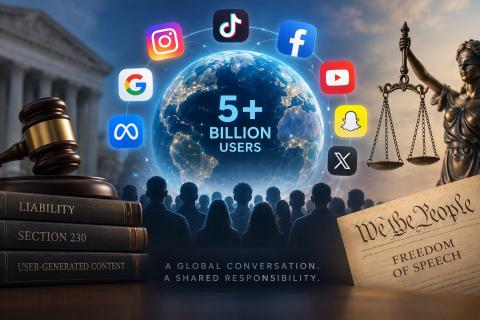
Can you imagine being held responsible for the actions of over five billion people? In today’s world, technology has become integrated into almost every aspect of society, such as work, school, and home activities, especially social media. With this evolution, it is commonly seen that people are encouraged to engage with at least one of the major social media platforms, like Instagram, Facebook, Snapchat, Tik Tok, etc. However, some individuals misuse these tools by engaging in unethical or illegal activities. They may attempt to sell illegal substances, participate in human or drug trafficking, or even exploit children. As a result, social media platform owners, like Meta and Google, are currently being sued by prosecutors who claim there are insufficient safety and protection protocols within these apps. However, these large companies cannot just restrict and deny access to suspicious users since doing so would be unconstitutional. Therefore, social media platforms should not be held fully responsible for harmful content posted by users because they cannot control every user action, already implement safeguards to reduce harmful content, are protected by existing laws regarding liability for user-generated content, and restricting user speech could potentially threaten their constitutional rights.
Going back to the question: Can you imagine being held responsible for the actions of over five billion people? Any reasonable thinker would take a step back and simply say “No.” DataReportal is a widely used digital research platform that compiles current global data on social media trends and user behavior. As of the start of April 2026, there’s a record of 5.79 billion user-accounts across all platforms (DataReportal). In his journal article on Section 230 and online intermediary liability, legal scholar Venkat Balasubramani states that social media platforms cannot realistically monitor every piece of content posted by billions of users: “Section 230 [...] gives providers and users of 'an interactive computer service' broad protection against liability for claims based on information ‘provided by another information content provider’”. This quote directly supports the argument that there are existing laws protecting these tools from
liability against user-generated content. It shows that Congress intentionally created legal protections for online intermediaries for content created by a third party. Furthermore, Balasubramani emphasizes the law’s continued protection when he states, “Since Zeran,
immunity for online service providers has largely remained broad”. In Zeran v. America Online, Inc. (AOL), the court ruled that AOL could not be held liable for harmful content posted by a third-party user. This landmark case established a broad interpretation of Section 230 and demonstrated the extent to which online platforms are shielded from accountability for user posts. The continued broad application of this law shows that platforms aren’t expected to be held responsible for their users’ content.
Furthermore, social media companies are well aware that some users misuse their platforms, and they have already incorporated several safeguards and moderation systems to reduce harmful content. According to legal scholar Ioanna Tourkochoriti, who specializes in social media regulation and digital rights, “It is not possible to dispense with human content moderators altogether” (142). This evidence highlights the limitations of automated moderation systems. Even advanced algorithms cannot independently identify every instance of harmful, misleading, or dangerous content online. As a result, platforms cannot realistically monitor every user’s actions, supporting the argument that they should not be held fully responsible for content created by their users. Tourkochoriti also notes that “Facebook appointed content moderators with linguistic and cultural expertise” (155). This statement demonstrates that social media
companies are actively investing resources into content moderation rather than ignoring harmful behavior. By employing specialists with cultural and language expertise, platforms show a commitment to improving user safety despite the challenges of moderating billions of interactions each day.
As mentioned before, it would be against the law, specifically the First Amendment, to excessively restrict an individual’s form of expression, including communication through social media. Constitutional law scholar Eugene Volokh explains that “Congress shall make no law […] abridging the freedom of speech, or of the press; or the right of the people peaceably to assemble, and to petition the Government for a redress of grievances”. This finding establishes the constitutional foundation for freedom of speech in the United States. It supports the argument that holding social media platforms fully responsible for user-generated content could encourage
excessive censorship, potentially limiting the free exchange of ideas and conflicting with the principles protected by the First Amendment.
Additionally, all these platforms are considered, by many, forms of communication, and so digital legal-rights scholar Edoardo Celeste argues that “What for many are the principal sources for knowing current events, checking ads for employment, speaking and listening in the modern public square, and otherwise exploring the vast realms of human thought and knowledge” (163). This quote shows that social media has become an important forum for communication and information in modern society. Because these platforms play such significant roles in public discourse, excessive restrictions on speech could limit individuals’ ability to participate in discussions and access information. Celeste also said, “Preventing individuals from using social media platforms or part of them restricts their capability to fully enjoy their fundamental rights” (178). This evidence directly supports the argument that restricting access to social media can affect freedom of expression and other constitutional rights. It suggests that efforts to aggressively regulate online speech may unintentionally reduce opportunities for lawful expression.
Some may argue that social media platforms incorporate algorithms that incentivize and/or construct harmful behaviors to keep users attached and addicted to their platforms. Media regulation researchers Augusto Santos, Regina Cazzamatta, and Carlo José Napolitano argue that “Platforms are not merely passive hosts; they actively construct public discourse through organization, searchability and algorithmic content selection” (730). This statement presents the opposing viewpoint that social media companies influence what users see online and therefore should bear more responsibility for harmful content. It serves as a strong counterargument to the claim that platforms are simply neutral hosts. On the contrary, Santos also states that “Harsh penalties can incentivize platforms to over-delete content to avoid fines, thus jeopardizing fundamental rights” (749). This research supports the argument that excessive liability can have unintended consequences. If social media companies fear legal punishment, they may remove lawful content simply to avoid potential lawsuits or regulatory penalties. As a result, users could lose opportunities to discuss political, social, or cultural issues, even when those discussions are protected by law. This type of over-censorship creates what is often called a chilling effect, where individuals become hesitant to share opinions out of fear that their content will be removed. If this approach is normalized, similar restrictions could influence other forms of communication and public discourse, potentially limiting the free exchange of ideas in society beyond social media platforms. Therefore, while platforms should continue addressing harmful content, excessive liability may ultimately threaten the fundamental rights it seeks to protect.
Social media platforms should not be held fully responsible for harmful content posted by users. With billions of accounts across social media, it is unrealistic to expect companies to monitor every post, comment, and interaction. Furthermore, platforms already employ content moderators, automated filters, and other safeguards to reduce harmful content and improve user safety. Existing laws, such as Section 230, recognize the practical limitations of content moderation and provide legal protections for platforms hosting user-generated content. Finally, holding platforms fully liable could encourage excessive censorship, and threaten the free exchange of ideas protected by the First Amendment. While social media companies should continue working to improve safety and moderation efforts, the responsibility for harmful content must ultimately remain with the individuals who create and share it. Society benefits most when online safety and freedom of expression are balanced rather than sacrificed for one another.


