

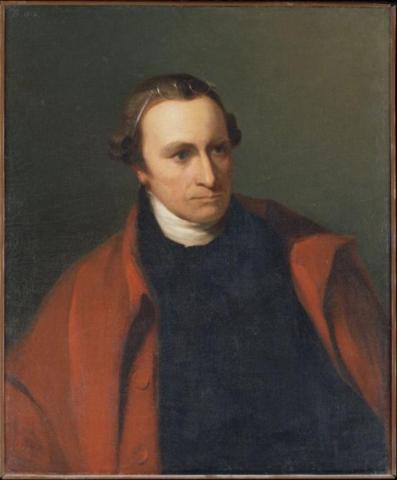
Prior to the American Revolution, 1775-1783, many issues arose in the operations of the American colonies. Cracks in the Articles of Confederation started to present themselves; the weak national government it created gave congress no power to tax or regulate trade among states. Major debates at the Constitutional Convention like representation, State vs. Federal powers, executive power, and slavery were all problems being fought and challenged over how they should be implemented in the Constitution or Articles of Confederation.
Patrick Henry was one of the many men who had fiery debates on these matters. Giving many renowned speeches like “Give Me Liberty or Give Me Death” which was one of the many speeches that gave him his infamous reputation as a persuasive rhetorician in the American colonies. Patrick Henry was one of Virginia's most outspoken anti-federalist wanting a strong central government, speaking out against the Constitution because of the fear of unchecked government powers leading to later political corruption.
In the rural county of Hanover VA on May 29, 1736, Patrick Henry was born on the Studley tobacco Plantation. His father, John Henry, was a first generation Scottish immigrant and a planter. While his mother, Sarah Winston Syme, was a young widow from a high status family, named the Winston Family, that was considered land rich. Patrick attended local schools, then later received the rest of his education from his father, who previously attended King’s College in Aberdeen.
At fifteen, Patrick began working as a clerk for a local merchant. Later, in 1752, Patrick and his older brother, William, opened their own merchant general store which later failed within a year due to the two boys’ relaxed policies on how much credit customers could use on goods, which ultimately ruined their cash flow. At eighteen, Patrick married sixteen-year-old Sarah Shelton, whose dowry was 300-acre farm land (known as the Piney Slash), a house, and six slaves. Patrick's father, John Henry, also provided them with “five or six” enslaved people to help start the beginnings of becoming a planter.
Patrick's first attempt at becoming a planter quickly faltered because of the lack of fertile soil on their plantation and the sudden house fire the Henrys’ faced in 1757. After a second attempt at storekeeping also fell short, Patrick helped his father-in-law at Hanover Tavern where he began to read law. By 1760, approaching his twenty-fourth birthday, Patrick decided to become a lawyer. With his self-taught education with law, he convinced Wythe and Randophl, who were both distinguished Virginian attorneys, that he had the knowledge and skill to pass the bar exam. With his charisma, talent, and influential family, Patrick Henry practiced law in the courts of Hanover and other surrendering counties.
In December 1763, Patrick Henry’s popularity and status began to grow with his victory in the Parsons’ Cause and disputes with the Two Penny Act of 1758. The Parson Cause was a legal lawsuit dispute between the Virginian colonies and the British Crown. In this case, Patrick Henry argued that the King has broken the social contract and has become a tyrant who has no right to interfere with taxation policies inside the American colonies. Quoting, “by disallowing acts of this salutary nature, far from being the father of his people, degenerates into a tyrant, and forfeits all rights to his subjects' obedience" (The Glorious Cause, Middlekauff, 83).
During the American Revolution, Patrick Henry was a very outspoken anti-federalist who was committed to the fact that liberty could only be obtained when power is given to the people in local and state governments; contrary to the idea of giving power to a singular central government. Because of this, Henry had many concerns on matters like the Constitution and Bill of Rights.
Henry argued that a singular centralized government power can morph into a tyrannic monarchy, like the one they last fought to escape and liberate from. Hence why Henry had a strong opposing belief for the ratification of the Constitution; calling it a "trifling evil” and how it would “entail misery” for the citizens of America. In a speech he asked for, “a full investigation of the actual situation of America” to determine if this path of governance was the best fit for the future of America. His issues with the Constitution stemmed in the worries that it concentrated too much power on a central government at the expense of states rights and liberties of the people and the loss of rights Americans already had under the Articles of Confederation.
To combat these issues relating to the Constitution, Henry demanded that the Bill of Rights be included in the Constitution during the ratification debates in Virginia. In this, he argued that it could abuse its power and threaten the freedom of the citizens of America. He believed people need written protection over their rights, such as freedom of speech, religion, and the right to a fair trial. Overall, Henry advocated adding a Bill of Rights because of his beliefs that protecting an individual's freedoms was of the utmost importance for the succession of creating a fair governance for America.
To finalize, Patrick Henry's ideology reflected the many concerns Americans had over giving the federal government centralized power from the shift from the Articles of Confederation to the Constitution. Henry strongly advocated that individuals rights and local/state governments needed protection from the worries of a tyrannical power that a centralized government gave off. His demand for a Bill of Rights to be added to the Constitution helped encourage the addition of amendments that protected citizens' freedoms. Henry's ideologies also help contribute to the political debates that formed early American political party systems. The altercations between those who supported a strong central government and those who supported a stronger state government helped lead to the creation of the Federalist and Democratic-Republician parties.
Overall, Patrick Henry’s ideologies influenced the disputes over how America should be governed and helped establish the importance of protecting individual liberty while balancing federal and state power.
Works Citations
(In Order of Titles)
Vaughn, Vanessa E. “Analysis: Patrick Henry Speech on the Ratification of the Constitution.” Research Starters, EBSCO, 2022, https://www.ebsco.com/research-starters/history/analysis-patrick-henry-speech-ratification-constitution/. Accessed 7 Oct. 2026.
Red Hill, Patrick Henry s. “Biography - Patrick Henry’s Red Hill.” Patrick Henry’s Red Hill, 20 Oct. 2020, https://www.redhill.org/patrick-henry/biography/. Accessed 7 Oct. 2026.
Bomboy, Scott. “Constitutional Voices: Patrick Henry’s Complex Legacy.” National Constitution Center – Constitutioncenter.Org, 26 June 2026, https://constitutioncenter.org/blog/constitutional-voices-patrick-henrys-complex-legacy. Accessed 14 Oct. 2026.
“George Washington’s Mount Vernon.” George Washington’s Mount Vernon, Mount Vernon, 2026, https://www.mountvernon.org/george-washington/constitutional-convention/issues-of-the-constitutional-convention. Accessed 8 Oct. 2026.
MAHONEY, DENNIS J. "Henry, Patrick (1736–1799)." Encyclopedia of the American Constitution, edited by Leonard W. Levy and Kenneth L. Karst, 2nd ed., vol. 3, Macmillan Reference USA, 2000, p. 1284. Gale In Context: U.S. History, link.gale.com/apps/doc/CX3425001208/UHIC?u=va_s_068_0330&sid=bookmark-UHIC&xid=fad49fd4. Accessed 1 Oct. 2026.
Red Hill, Patrick Henry s. “Liberty or Empire? - Patrick Henry’s Red Hill.” Patrick Henry’s Red Hill, 20 Oct. 2020, https://www.redhill.org/speeches-writings/liberty-or-empire/. Accessed 14 Oct. 2026.
Wynne, Ben. “Patrick Henry.” George Washington’s Mount Vernon, https://www.mountvernon.org/library/digitalhistory/digital-encyclopedia/article/patrick-henry. Accessed 8 Oct. 2026.
“Patrick Henry: Defender of American Liberty.” The Heritage Foundation, 2019, https://www.heritage.org/american-founders/leading-founders/patrick-henry-defender-american-liberty. Accessed 8 Oct. 2026.
"Patrick Henry." Encyclopedia of World Biography Online, Gale, 1998. Gale In Context: Biography, link.gale.com/apps/doc/K1631002976/BIC?u=va_s_068_0330&sid=bookmark-BIC&xid=7d3bb845. Accessed 1 Oct. 2026.
“Parson’s Cause.” Historic St. John’s Church, 1741, https://www.historicstjohnschurch.org/parsons-cause. Accessed 7 Oct. 2026.
Carbonara, Michael. “What Was Patrick Henry’s Stance on the Bill of Rights?” Michael Carbonara for U.S. Congress – Florida’s 22Nd District, 11 Mar. 2026, https://michaelcarbonara.com/patrick-henry-bill-of-rights-explained/. Accessed 7 Oct. 2026.


