

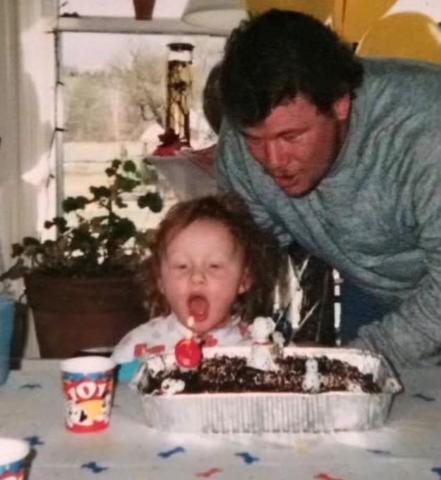
There are some people you lose all at once.
And then there are the people you lose slowly.
Piece by piece. Conversation by conversation. Through slammed doors, broken promises, and the unbearable silence that follows words you can never take back.
You watch them disappear while they're still standing in front of you. You memorize the person they used to be, searching for glimpses of them in someone you no longer recognize. You convince yourself that if you love them enough, wait long enough, or pray hard enough, maybe they'll find their way back.
And sometimes, they almost do.
My father was one of those people.
For nearly twenty years, my dad was sober.
Twenty years.
Long enough for me to grow up believing that the darkest parts of his life were behind him. Long enough for him to become the man I admired, the husband I looked up to, and the father I believed could overcome anything.
He wasn't a perfect man. Our family's history had its share of darkness, and his past was never something that could simply be erased. But I watched him build a life beyond it.
And somewhere along the way, he became my hero.
Not because he was extraordinary in the ways the world measures greatness, but because of the ordinary things that made him my dad.
Takeout dinners. Nights watching Silent Hill. The sound of his voice. The way he would tickle my back. The familiar comfort of knowing he was there. The pride I felt when he showed up for me.
I didn't know those ordinary moments would someday become the memories I would cling to just to remember what it felt like to have him.
I didn't know there would come a time when I would give anything to sit beside him again, doing absolutely nothing.
I didn't know that the man I spent my childhood idolizing would become someone I needed protection from.
And I certainly didn't know that one day, I would be standing in a dirty motel room, searching through what remained of his life, wishing I could find even the smallest piece of the father I remembered.
Because after nearly twenty years of sobriety, my dad relapsed.
And the man I knew began to disappear.
It wasn't immediate. There was no single moment when I could point to him and say, There. That's when I lost my father.
It happened slowly, in ways that are difficult to explain to someone who has never watched addiction unravel a person they love.
The man whose presence once brought comfort began bringing fear.
The voice that once made me feel safe became the voice I dreaded hearing.
The home that had held so many of our memories became a place where we walked carefully, never knowing what version of him we would encounter.
There were years of screaming. Years of being degraded, threatened, and made to feel small by someone whose opinion had once meant everything to me.
And eventually, the violence was directed toward me.
My dad.
The man I idolized.
The man I had spent most of my life believing would protect me from the very things he had become capable of doing.
The father I knew in sobriety would never have even considered hurting me.
I cannot explain how deeply it changes you when the person you once ran to for safety becomes the person you need safety from.
It's a betrayal that doesn't fit neatly into anger or sadness.
Because beneath the fear, I still loved him.
Beneath the resentment, I still missed him.
And beneath every terrible thing that happened, there was still a little girl inside me waiting for her dad to come back.
In April 2023, my father was removed from our home.
After years of threats, emotional abuse, and escalating violence, we were granted a one-year Relief From Abuse order.
A piece of paper that legally required the man I had spent my life loving to stay away from us.
I don't think people understand what it feels like to need a court order to protect yourself from your own father.
To know that the person whose name you carry, whose features you recognize in your own face, whose memories are woven into nearly every part of your childhood, has become someone you cannot safely allow through your front door.
We didn't want that life.
We didn't want police involvement, court orders, or a home that felt divided by fear.
We wanted my dad.
We wanted the husband and father who had spent nearly twenty years showing us that recovery was possible.
And when he was removed from our home, we held on to one desperate hope.
Maybe this will be enough.
Maybe losing the home he loved would make him realize what addiction had cost him.
Maybe being separated from his family would force him to confront the person he had become.
Maybe he would finally understand that we weren't trying to punish him.
We were trying to survive him.
And we were praying he would survive himself.
The order was set to expire in April 2024.
That date became something I quietly held on to.
A year.
A year for him to find sobriety. A year to heal. A year to recognize the damage he had caused. A year to become someone we could safely welcome home again.
I never expected him to become perfect.
I just wanted him to become my dad again.
During that time, I stopped speaking to him.
Not because I had stopped loving him.
But because I had reached a point where loving him from a distance was the only way I knew how to protect myself.
I even changed my last name.
There is something heartbreaking about feeling the need to separate yourself from a name that once connected you to someone you adored.
But I was tired.
Tired of the threats. Tired of being hurt. Tired of mourning a man who was still alive.
I needed to remember who I was outside of the pain our family had endured.
And still, even after changing my name, I remained his daughter.
I still carried his memories.
I still heard his laugh in my head.
I still remembered the feeling of his hand gently tickling my back.
And I still hoped that one day, when he was healthy again, I could tell him how much I had missed him.
But there is something else I carry from those final days of our relationship.
Something I wish I could forget, but know I probably never will.
The last words I ever heard my father say to me were about what an awful person he believed I was.
He told me he had failed at raising me.
Those were the last words I heard from my dad.
Not I love you.
Not I'm sorry.
Not I'll get better.
He told me I was an awful person and that he had failed as my father.
I have replayed those words more times than I care to admit.
There is something uniquely painful about being told you're a disappointment by someone you spent your entire childhood trying to make proud.
I had spent so many years looking up to him, admiring the man he had become, believing in his strength and his ability to overcome anything.
And the last thing he left me with was the belief that I had somehow become his greatest failure.
I wish I could say I knew those words weren't true the moment he said them.
But words spoken by a parent have a way of finding the parts of us that are still children.
Even when we're grown.
Even when we know better.
Even when the person saying them is no longer the person we remember.
I wanted to believe that it wasn't really my dad speaking.
That the man I knew in sobriety would have been horrified by the things he had said to me.
But that didn't make the words hurt any less.
And when he died, those words became permanent in a way I never expected.
Because there would never be another conversation to replace them.
No apology.
No chance for him to tell me he was proud of me.
No opportunity to hear him say that he hadn't meant it.
Just the memory of his voice telling me he had failed at raising me.
And the silence that followed.
I thought we had time.
That's the part that hurts the most.
I thought we had time.
On February 3, 2024, my father died alone in a motel room in Rutland, Vermont.
He was fifty-nine years old.
His cause of death was a fentanyl overdose.
Fentanyl.
Even now, that word feels foreign when placed beside my father's name.
The man I grew up knowing would never have imagined that his life would end that way. The father who had spent nearly twenty years in recovery, who had built a life and a family, was gone because of a substance I could never have imagined being part of his story.
He died alone.
Not in the home we had hoped he would return to.
Not surrounded by the people who loved him.
Not with someone holding his hand and telling him he was going to be okay.
Alone.
In a dirty motel room.
I was twenty-nine years old and four months pregnant with my youngest child.
And I still don't know if my dad ever knew.
I don't know if he knew another grandchild was coming. I don't know if he imagined the possibility of holding that baby someday. I don't know whether he knew there was another little life growing inside me while I was quietly hoping he would find his way back into ours.
There are questions that grief leaves unanswered.
And then there are questions that become part of you.
That is one of mine.
After he died, I went to the motel to collect his belongings.
I wanted to find something of his. Something meaningful. Something that still smelled like him or reminded me of the man I had known.
I wanted to find the pieces of my father that addiction hadn't taken.
Instead, I walked into the place where he had died.
The room was filthy.
Body tags were scattered across the room.
And on the floor was a pool of blood that had poured from his face.
His blood.
My father's blood.
I stood in a room where the man who once made me feel safe had taken his final breaths, and there was nothing I could do to change any of it.
I couldn't call him.
I couldn't wake him.
I couldn't ask him what happened.
I couldn't tell him that I was sorry things had become so painful between us.
I couldn't tell him that I loved him.
All I could do was stand there, surrounded by what remained of his life, and try to understand how the man I had once idolized had ended up dying this way.
I had spent years watching my father disappear.
But nothing prepared me for seeing the place where he disappeared forever.
Among his belongings, we found journals.
Pages filled with pieces of his life.
Some were written during better days, when his thoughts seemed clearer and the man I remembered was easier to recognize.
Others were harder to read. Fragments of memories. Thoughts that seemed to collide with one another. Words that wandered across the pages as though he were desperately trying to hold on to something he couldn't quite put together.
And I read them.
Because they were his words.
Because after so much silence between us, those pages were one of the few things I had left.
Because somewhere inside those journals, I hoped I might find my dad.
I wanted to know what he had been thinking. Whether he missed us. Whether he understood why we had needed him to leave.
Whether he knew we were still waiting.
And then, after his death, we learned something that broke my heart all over again.
My dad had gotten sober.
Again.
We learned that he had reportedly been sober for a few months and had been working toward coming home and apologizing.
The very thing we had spent so long praying for.
The very thing I had convinced myself might happen when April finally arrived.
He had been trying.
And we hadn't known.
I cannot explain what it feels like to discover that the person you were waiting for may have been finding their way back to you, only after you've lost the chance to welcome them home.
For so long, I had imagined what that conversation might look like.
Would he apologize?
Would he acknowledge what he had done?
Would he understand how deeply he had hurt us?
Would I recognize his voice again?
Would I finally be able to hug my dad without fear?
I had imagined the possibility of healing.
I had not imagined that death would arrive first.
But there was another piece of his story we learned after he was gone.
My father had been diagnosed with heart failure and cirrhosis of the liver.
He had reportedly been given only months to live.
After nearly twenty years of sobriety, after losing himself to addiction, after finally beginning to find recovery again, his body was failing him.
And I have spent countless nights wondering what that must have felt like.
Did he know how sick he was?
Was he afraid?
Did he want to come home but believe he no longer deserved to?
Did he think we would reject him?
Or did he believe that allowing us to watch him become weak and sick would hurt us more than staying away?
I have a belief that I cannot prove.
Part of me believes my dad intended to die in that motel room, away from us, because he couldn't bear the thought of his family watching him deteriorate from his diagnoses.
I don't know whether that was truly his intention. I don't know what was in his mind during his final hours, and I know that his death from a fentanyl overdose does not, by itself, tell me what he meant to happen.
But I knew the pride my father once carried. I knew the man who had spent years being strong for us.
And sometimes I wonder whether, in his own way, he thought he was protecting us from seeing him at his weakest.
What he couldn't have known was that I would have taken every one of those difficult days over never seeing him again.
I would have sat beside him.
I would have held his hand.
I would have listened to his apologies, even if I wasn't ready to forgive everything.
I would have wanted the chance to tell him about the baby I was carrying.
I would have wanted him to know that his illness did not make him unworthy of love.
That he didn't have to be the strong man I remembered.
That he could have been sick, frightened, ashamed, or uncertain, and still been my dad.
I would have wanted him to know that being loved and being allowed back into our home were not the same thing. We still needed safety. We still needed accountability. But there was room for love even when there wasn't room for him to return yet.
And more than anything, I would have wanted him to know that we had never stopped loving him.
That is the part of his death that I struggle with most.
The possibility that my father died believing his family had abandoned him.
That he spent his final months thinking we no longer wanted him.
That the man who had once been the center of so many of our lives believed there was no place left for him in them.
When the truth was that we were waiting.
We were waiting for April.
Waiting for recovery.
Waiting for an apology.
Waiting for the day when we might open the door and recognize the man standing on the other side.
We weren't waiting for him to become someone new.
We were waiting for him to remember who he had been.
And he died before that day could come.
There is a kind of guilt that follows you after losing someone you were estranged from.
It lives in the conversations you never had.
The phone calls you didn't make.
The words you thought you would have time to say.
It makes you question decisions you made to protect yourself, even when you know those decisions were necessary.
I know why I stopped speaking to my father.
I know why we needed the RFA.
I know that addiction did not excuse the threats, the degradation, or the violence.
And I know that being someone's daughter did not mean I was obligated to endure abuse.
But I also know that I loved him.
And sometimes, those two truths feel almost impossible to carry together.
I can understand the psychology of addiction. I can study trauma, substance use disorders, relapse, and recovery. I can recognize that nearly twenty years of sobriety were not erased by the fact that he struggled again.
I can understand that addiction is complicated.
But none of that changes the fact that I was a daughter who wanted her dad.
Not a case study.
Not a diagnosis.
Not another statistic.
My dad.
The man who watched movies with me.
The man who made me laugh.
The man whose ordinary acts of love became the memories I would spend the rest of my life protecting.
And that is something I wish more people understood about addiction.
There are families who love someone deeply and still cannot safely be near them.
There are children who miss their parents while being terrified of what those parents have become.
There are people who have to choose between their own well-being and the relationship they once treasured.
And there are families who spend years grieving someone who is still alive, only to be told one day that the person they were waiting for is never coming back.
I want to dedicate my life to trauma-informed mental health advocacy because I know what it feels like to live on both sides of that reality.
I know what it means to love someone who is struggling.
And I know what it means to be hurt by them.
I know that compassion matters.
But so does accountability.
So does safety.
So does the pain carried by the people who survive the chaos addiction leaves behind.
I don't want my father's life reduced to his relapse.
I don't want his story to begin and end in that motel room.
Because before the threats, before the violence, before the court order, and before the fentanyl, there was a man who spent nearly twenty years fighting for a better life.
There was a father who showed up.
A husband who was admired.
A man who gave his daughter memories she would one day wish she could crawl back into.
And there was a little girl who believed her dad could overcome anything.
That little girl grew up.
She learned that love doesn't always save people.
She learned that protecting yourself can be one of the most painful decisions you'll ever make.
She learned that sometimes, the people you love most can become the people who hurt you most.
And she learned that you can do everything you need to do to keep yourself safe and still spend the rest of your life wishing the ending had been different.
April 2024 came without my dad.
The month we had spent so long hoping would mark a new beginning became another reminder that he was gone.
The RFA was supposed to expire.
We were supposed to have a chance to see what recovery had changed.
There were supposed to be conversations.
There were supposed to be apologies.
There was supposed to be time.
Instead, I had journals, memories, and questions that would never be answered.
And a baby growing inside me who would never know the man I had spent my childhood loving.
I think about that often.
How my youngest child will never know the sound of his laugh.
How she will never sit beside him watching a movie.
How she will never experience the version of my father that made me feel so loved.
And I wonder how I will explain him someday.
How do you tell a child about someone who was both a source of love and a source of pain?
How do you explain that a person can do terrible things and still have been deeply loved?
How do you honor the beautiful parts of someone's life without pretending the painful parts never happened?
I don't have all the answers.
But I know I will tell the truth.
I will tell her that her Pip struggled.
That he made mistakes.
That he hurt people who loved him.
But I will also tell her that he fought for recovery, that he gave me memories I still treasure, and that he was more than the circumstances of his death.
I will tell her that addiction can change the course of a life, but it does not erase every good thing that came before it.
And I will tell her that love and boundaries can exist together.
Because that is what my father taught me, even if it wasn't the lesson either of us wanted.
I don't know if my dad died knowing how much I loved him.
I don't know if he understood that the silence between us was never meant to be permanent.
I don't know if he knew that I still remembered the man he had been, or that I was still hoping to see him again.
But if I could have one more moment with him, I wouldn't spend it asking why.
I wouldn't spend it reminding him of everything that went wrong.
I would tell him that I missed him.
That I had missed him for years.
That I had spent so long searching for him in a person I no longer recognized.
And that even when I couldn't safely have him in my life, I never stopped wanting him to get better.
I would tell him about the baby.
I would tell him that I was proud he had tried to find sobriety again.
I would tell him that I wished we had been given more time.
And then I would tell him the one thing I hope, somehow, he already knew.
Dad, we never stopped loving you.
We were waiting for you.
We were waiting for the man we knew to come home.
And I am so sorry that the world ran out of time before we got to open that door.
I have spent years trying to make peace with a goodbye that never felt finished.
I have learned that grief is not always about losing someone who was present until the very end.
Sometimes, it's about losing someone slowly, loving them from a distance, and carrying the hope of reconciliation until there is nowhere left for that hope to go.
Sometimes, it's about realizing that the last conversation you had with someone was the last conversation you'll ever have with them in this lifetime.
And sometimes, it's about being a grown woman, a mother, and someone who understands far more about trauma and addiction than she ever wanted to, while still feeling like a little girl who just wants her dad.
My father died on February 3, 2024.
But I had been losing him for years.
And somewhere between the man he was, the man addiction made him, and the man he was trying to become again, I lost the chance to tell him that I was still here.
Still his daughter.
Still loving him.
Still waiting for April.